


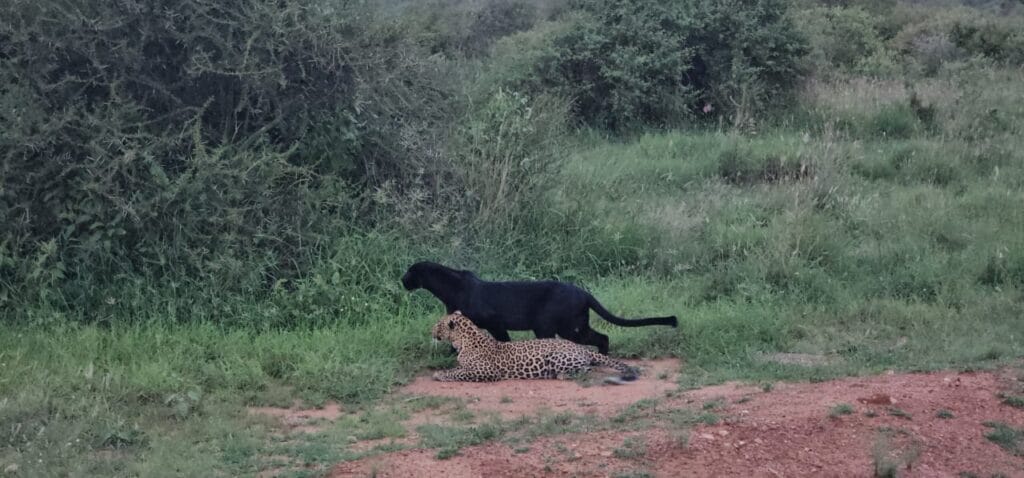
There are few places in Africa that create as much excitement amongst safari guides as the wilderness areas of Laikipia, Kenya. Known for its vast open landscapes, thriving wildlife populations, and pioneering conservation efforts, Laikipia has become one of East Africa’s premier safari destinations. It is also one of the few places on the continent where visitors have a realistic opportunity of encountering one of Africa’s most elusive predators—the black leopard.
Our recent stay in Laikipia with two guests was nothing short of extraordinary.
Unlike many luxury safari destinations, our camp embraced a more rustic and authentic approach to life in the bush. Comfortable canvas tents, campfires under the stars, and the sounds of wildlife throughout the night reminded us that safari is not always about polished luxury—it is about experiencing nature as closely as possible.
One of the things that immediately stood out was the atmosphere within camp itself. The guides and camp staff live and breathe wildlife. Their enthusiasm is infectious. When a radio call comes through announcing a special sighting, the excitement amongst the guides is often equal to that of the guests. It creates a wonderful sense of anticipation and camaraderie that is difficult to find elsewhere.
Of course, everyone arrives in Laikipia hoping for one particular sighting.
The black leopard.
For years, Laikipia has become famous worldwide thanks to repeated sightings of a melanistic leopard affectionately known as “Giza.” Unlike ordinary leopards, Giza’s dark coat gives her an almost mythical appearance, especially in the soft light of dawn or dusk. While her distinctive rosettes remain visible up close, from a distance she appears almost completely black.
We were fortunate enough to spend time with Giza during our stay, and it was every bit as special as one would imagine. Watching her move gracefully through the landscape reminded us why she has become one of Africa’s most celebrated big cats.
As if the black leopard wasn’t enough, we were also rewarded with sightings of two striped hyenas. Far less commonly seen than their spotted cousins, striped hyenas are one of Africa’s most overlooked carnivores. Their shaggy coats, distinctive markings, and secretive behaviour made this a particularly memorable encounter.
Not all adventures involve predators.
While exploring an area far from established roads, we found ourselves navigating through thick bush when an elephant decided we were a little too close for comfort. What followed was a rapid retreat and a healthy reminder that wildlife always dictates the terms in Africa. Thankfully, both guests and guides escaped with nothing more than elevated heart rates and a story that will be told around campfires for years to come.
Laikipia’s conservation history is one of the reasons wildlife thrives here today. Much of the region consists of privately managed conservancies and ranches that have successfully balanced wildlife conservation with local community involvement. Over the past several decades, these efforts have transformed Laikipia into one of Kenya’s most important wildlife strongholds, supporting endangered species such as black rhino, Grevy’s zebra, African wild dog, and, of course, the famous black leopard.
As our time in camp came to an end, we left with incredible memories, new friendships, and a renewed appreciation for wild places that continue to protect some of Africa’s rarest animals.
For those seeking a safari experience that combines adventure, character, conservation, and the possibility of seeing one of the world’s most elusive cats, Laikipia remains one of Africa’s finest destinations.
— Clint Robertson
Private Guide
Umdingi Safaris

